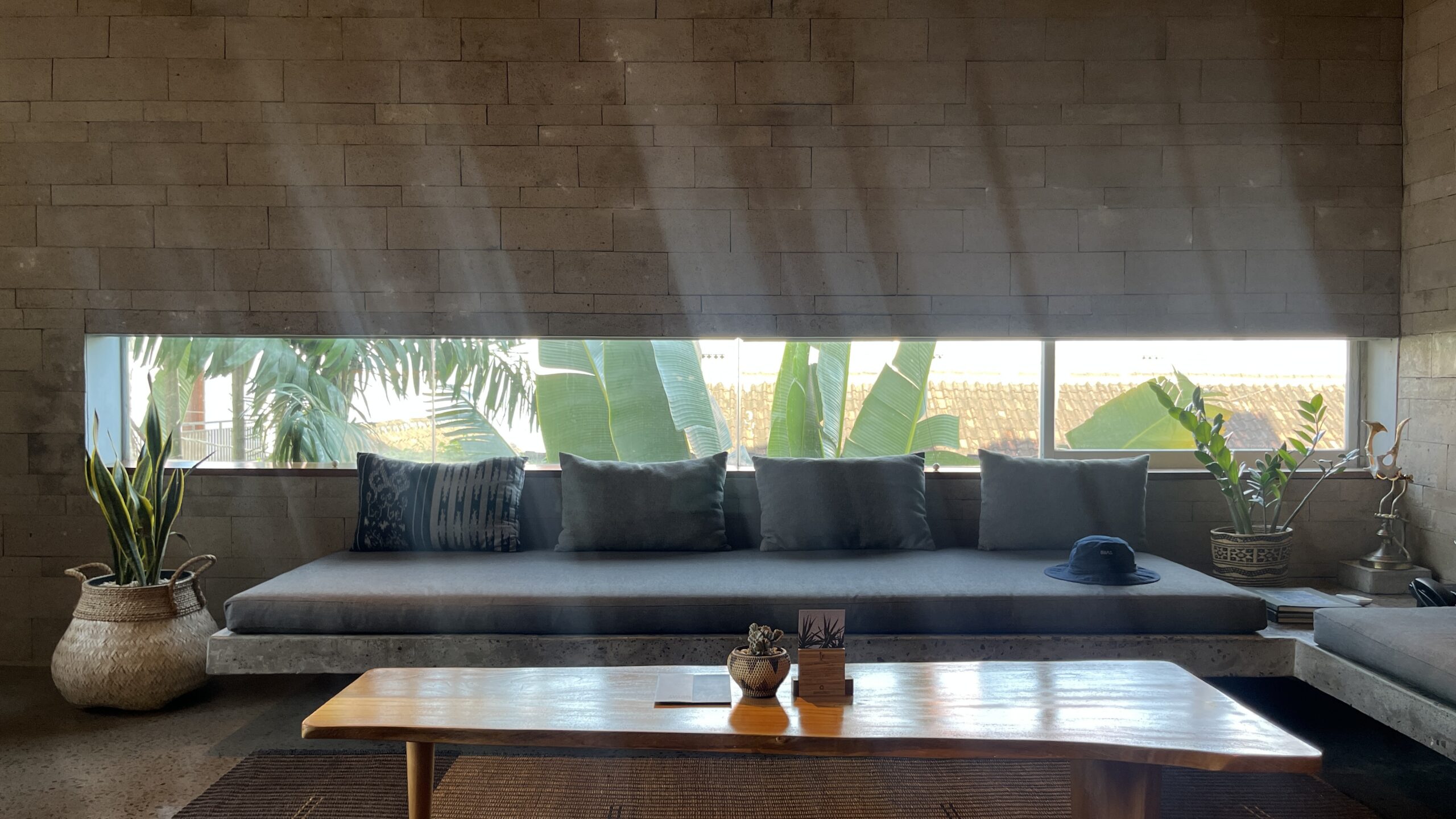
I visited Bali in May and stayed in a rare-of-its-kind hotel in Canggu, The Slow. It is not the most luxurious hotel I stayed on the island, but it’s definitely the most memorable one: For the fact that I felt time slowed down (calming), and I barely stepped out of the hotel during my three-day stay there.
Main Design Feature of The Slow Canggu
The owner, George Gorrow, and local architect from GFBA Architects incorporate local, raw materials such as stone tiles, tropical wood, metal, and textiles, composing a stark yet ultimately modern and calming space.
If you are interested in its overall “Tropical Brutalist” design and inspirations, you can check the article on Habitusliving. Here, I want to expand on the elements that made my stay extra calming and relaxing.
Textures and Materials that Promote Relaxation
In its sleeping and living rooms, The Slow uses concrete, raw and polished, and wood as the base tone architecturally. These two materials have a natural calming quality, unlike paint, plastic, or other composite materials seen often in hotel interiors.

In the bathrooms, a sand-mixed tile lifts up the space in a lighter tone. It blends well between the concrete floors and the wood counter and cabinets. It is also an aesthetic material for the indirect wash-down lights.


Soft architecture are gray linen, vintage fabric, and cheese cloth. The bath robe also feels like some sort of cheese cloth, but in a black color. I bought one bath robe for its nice design.

Small architectural items such as light switches and outlet plates are finished in brushed stainless steel, avoiding typical plastic plates that would stand out uncomfortably on a concrete toned wall.

Organic and Biophilic Design
We know that biophilic elements are a major contributor to the calmness of a space. Here, you will find some house plants in the room, and swaying palms right outside of the windows.

The majority of the materials, concrete, wood, and sand-textured tiles, carry their natural grain as the secondary biophilic layer.
The Picture Window by the Couch
The highlight of the room is the picture window on one side of its walls. The window, framed by thin metal plates, appears more like a precise incision in the wall than a conventional window frame. As if the swaying palms outside the window is a moving picture.

In front of the window, a floating concrete platform functions as the couch invites you to lounge, sit, or lie down.
In lighting design, we know the trick to place the light source lower, to create a calming feel. In nature, the sun sits lower on the horizon during sunrise and sunset. Our body’s circadian rhythm tends to be more relaxed during these periods, which is why placing light sources at a lower level is a common technique in lighting design to evoke a sense of calm.

Have you ever thought about how to place a window on a wall? When a window is placed in the middle part of a wall, it’s usually the worst design decision. Below are two images by the French architect Lacaton Vassal, showing how they improve a bedroom by redesigning the window opening and adding a balcony. Note they use a purple curtain, same color as the bedsheet, to create spatial depth. In The Slow, they use the house plant to create the same effect.

Critic
One critic I should mention is that the hotel lacks a well-designed transition space, or lobby, for visitors to transit from the busy Canggu street to its slow environment.
If You Go
If you ever go and stay there, you will also find each room with built-in speakers that can play curated music all-day-long, to help you lounge and relax. Also, a good touch: The wifi password is “takeitslow”.


